Melbourne Pool Safety Inspections: The Complete Homeowner's Guide to Compliance
- J B
- May 26
- 12 min read

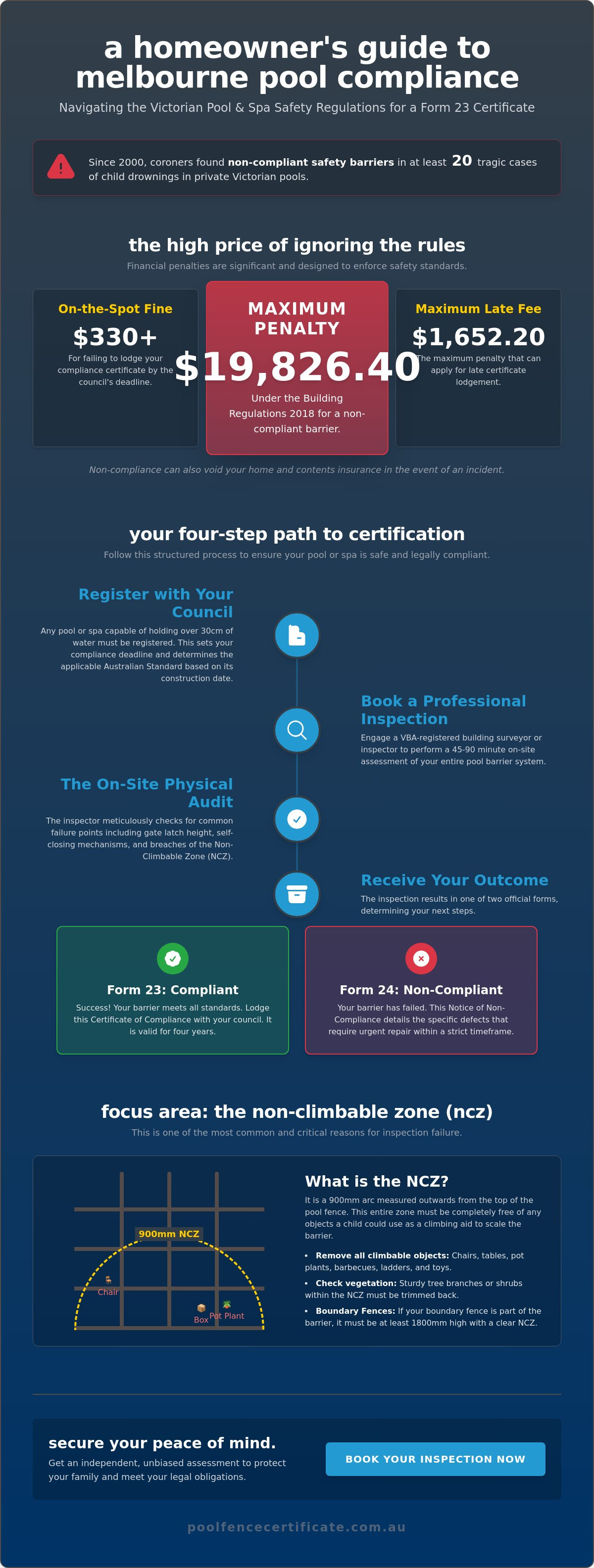
Did you know that since 2000, 27 children have tragically drowned in private Victorian pools, with coroners finding non-compliant safety barriers in at least 20 of those cases? This sobering statistic highlights why the state government enforces such rigorous standards for melbourne pool safety inspections. As a homeowner, you likely feel the weight of this responsibility, yet the fear of heavy council fines and the struggle to interpret complex regulatory jargon can make the path to compliance feel overwhelming. You deserve the peace of mind that comes from knowing your home is a safe environment, free from the risk of a $19,826.40 penalty.
This expert guide provides a clear roadmap to help you understand the new AS 1926.1:2024 standards and secure your Form 23 Certificate of Pool and Spa Barrier Compliance with confidence. We'll walk you through the essential registration steps, explain the impact of the May 2026 legislative updates, and outline a structured approach to ensuring your barrier meets every legal benchmark. From understanding the new 1800mm boundary height rules to finalising your council lodgement, we have simplified the process so you can focus on enjoying your pool safely.
Key Takeaways
Understand the legal requirements of the 2019 Victorian legislation and the mandatory four-year cycle governing all residential pools and spas.
Navigate the step-by-step roadmap for melbourne pool safety inspections to ensure your property moves efficiently from council registration to the final lodgement of your Form 23 Certificate.
Identify the specific Australian Standard that applies to your pool barrier to ensure your assessment is based on the correct historical legal benchmarks.
Recognise the most common causes of inspection failure, including Non-Climbable Zone (NCZ) breaches, to prepare your property for a successful outcome.
Learn how an independent, inspection-only approach provides an unbiased assessment of your safety barrier, protecting both your family and your legal standing.
Table of Contents
Understanding Mandatory Pool Safety Inspections in Melbourne
The 2019 legislative shift fundamentally changed the responsibilities of Victorian property owners. This move transitioned pool safety from a voluntary check to a strictly regulated mandatory lifecycle. Today, melbourne pool safety inspections are a legal necessity that occurs every four years. The Victorian Building Authority (VBA) serves as the industry watchdog, regulating the registered building surveyors and inspectors who perform these audits. This oversight ensures that every assessment adheres to the rigorous benchmarks designed to prevent avoidable tragedies. Local councils across Melbourne's eastern suburbs, such as Monash, Whitehorse, and Knox, have ramped up enforcement. They're currently cross-referencing property data to identify unregistered structures and issuing formal notices to owners who've fallen behind.
Why Your Pool Must Be Registered with Council
Council registration isn't just a clerical task; it's the foundation of your legal safety standing. Any structure, whether a permanent inground pool or a relocatable spa, that can hold more than 30cm of water must be registered. Councils charge varying fees for this service. For example, the City of Melbourne currently charges $90.40 for pools built before November 2020. Your registration triggers a deadline for your first inspection. To determine which swimming pool safety standards apply to your barrier, you must know your pool's construction date. If you don't have the original building permit, contact your council's building department to request a property search. This date is critical because it dictates whether your barrier is assessed against older standards or the most recent 2024 updates.
The Legal Gravity of Non-Compliance
The financial consequences of neglecting your melbourne pool safety inspections are severe and immediate. Failing to lodge your compliance certificate by the council's deadline can lead to an on-the-spot fine of roughly $330, with maximum penalties reaching $1,652.20. However, the most significant risk lies in the barrier itself. If your safety barrier is found to be non-compliant and you fail to rectify it, you could face fines of up to $19,826.40 under the Building Regulations 2018. There's also the matter of your household's financial protection. Non-compliance can directly impact your liability coverage. It's essential to understand the connection between pool compliance and home insurance victoria, as a lapse in certification could lead to a denied claim in the event of an incident. Taking action now protects your family and your financial assets from these avoidable risks.
The Victorian Inspection Process: From Booking to Form 23
The path to compliance begins when your local council issues a formal notice. This document specifies your pool's applicable standard and your deadline for lodgement. Ignoring this notice is not an option; it triggers a legal process that can result in significant financial penalties. To resolve this, you must engage a registered inspector to perform one of the mandatory melbourne pool safety inspections. This site visit typically lasts between 45 and 90 minutes, depending on the complexity of your barrier and the number of gates present.
The outcome of this visit is documented in either a Form 23 or a Form 24. A Form 23 Certificate of Pool and Spa Barrier Compliance is the primary objective. It confirms your barrier meets the Victorian pool safety regulations and is valid for four years. Conversely, a Form 24 Notice of Non-Compliance is issued if the barrier fails to meet the standards. This notice outlines the specific defects that require urgent attention and sets a countdown for mandatory repairs.
Step 1: The On-Site Physical Assessment
When the inspector arrives, they conduct a rigorous physical audit of your entire barrier system. This is a technical assessment rather than a simple visual scan. They measure the height of gate latches to ensure they're out of reach for young children. They apply specific force to gates to verify they self-close and self-latch from any open position, including when resting on the latch. The inspector also scrutinises the Non-Climbable Zone. This 900mm radius must be clear of any objects, such as pot plants, chairs, or sturdy tree branches, that a child could use to scale the fence.
Step 2: Receiving Your Compliance Report
Following the assessment, you'll receive a detailed report. If your barrier passes, your Form 23 will be issued promptly. However, if defects are identified, Victorian law provides a 60-day window for you to complete the necessary repairs. This period is a strict legal timeframe. If a follow-up inspection doesn't occur within these 60 days, the inspector is legally obligated to notify the council, which may lead to a Form 24 and subsequent fines. To ensure you stay within these legal boundaries, you should book your professional inspection as soon as your council letter arrives.
Deciphering the Standards: Which Rules Apply to Your Pool?
One of the most frequent points of confusion for homeowners is the assumption that every pool must meet the same modern criteria. This is incorrect. The standard applied to your property is determined by the date the pool was constructed. This chronological link ensures that older pools are not unfairly penalised by modern engineering requirements, provided the original safety measures have been meticulously maintained. When you engage a professional for melbourne pool safety inspections, their first task is to identify which of the five primary Victorian standards applies to your specific barrier.
These standards range from the early AS 1926-1986 through to the newly implemented AS 1926.1:2024, which became effective on 1 May 2026. If you undertake major renovations, such as remodelling the pool shell or replacing more than half of the existing fence, the "grandfathering" of older rules typically ends. In these scenarios, the law requires you to upgrade the entire barrier to the current National Construction Code (NCC) 2025 specifications. It is vital to work with an inspector who understands these historical nuances to avoid being forced into unnecessary and expensive upgrades that your specific era doesn't legally require.
Pre-1991 vs. Post-2010 Requirements
The regulatory gap between older and newer pools is substantial. For barriers built before 1991, the rules regarding gate swing directions and latching mechanisms are often less restrictive than modern mandates. However, boundary fences are treated with increasing rigour across all eras. Under the 2024 standard, the 500mm non-climbable zone rule no longer applies to boundary barriers if there's a vertical height of 1800mm from the top to the finished ground level. Indoor pools and spas also face unique challenges, as the requirements for windows and doors acting as part of the barrier have tightened significantly over the last decade.
The Role of the Australian Standard (AS 1926.1)
AS 1926.1 is the technical foundation for all melbourne pool safety inspections. It serves as the definitive reference for every measurement, from the gap under a fence to the tension required for a self-closing gate. While the document is complex, it allows for "deemed-to-satisfy" solutions. These are alternative methods of achieving safety when a standard layout isn't possible due to the property's topography or existing structures. A seasoned inspector uses this technical bible to find a compliant path for tricky layouts without compromising the safety of the household or the integrity of the law.
Common Pitfalls: Why Melbourne Pools Fail Inspection
A single misplaced pot plant or a slightly weathered hinge can be the difference between a Form 23 and a costly council fine. In Melbourne's eastern suburbs, the failure rate for initial melbourne pool safety inspections remains significant, primarily because homeowners often overlook the technical details of the Victorian standards. While the legislation is designed to save lives, its application is rigorous and leaves no room for error. You must view your barrier not as a static fence, but as a functioning safety system that requires constant vigilance and maintenance to remain legally compliant.
The most frequent cause of failure is the breach of the Non-Climbable Zone (NCZ). This is followed closely by gate malfunctions and boundary fence issues. In suburbs with established gardens and undulating terrain, such as Ringwood or Glen Waverley, natural factors like tree growth and soil movement often compromise previously compliant barriers. Identifying these issues early is the only way to avoid the stress of a 60-day rectification window and the potential for a Form 24 Notice of Non-Compliance. To ensure your barrier is ready for a formal assessment, you should book a professional pool barrier inspection to identify these mechanical failures before they become legal liabilities.
The 900mm Non-Climbable Zone Explained
The NCZ is a 900mm quadrant measured from the top of the barrier. Any object that provides a foothold or handhold within this zone is a violation. Common culprits include BBQ equipment, decorative pot plants, and even low-hanging branches from overhanging trees. Glass fences require extra attention; while they offer aesthetic appeal, any nearby ledge or 'foothold' can facilitate a climb. Critically, you must also monitor the neighbour's side of the fence. If your neighbour places a shed or a woodpile against the boundary, your barrier may no longer meet the 1800mm vertical height requirement, rendering your pool non-compliant through no fault of your own.
Gate Latches and Self-Closing Mechanisms
A safety gate must self-close and self-latch from any position, including when it's just a few centimetres from the latch. If you have to 'check' that it's closed, it has already failed the standards required during melbourne pool safety inspections. Weather conditions and ground movement in areas like Glen Waverley frequently cause gates to sag or hinges to lose tension, leading to inconsistent latching. Testing the latch from a stationary start and from various angles is a core part of the audit. Inspectors will test the gate by letting it close from a nearly shut position to see if the momentum is sufficient to engage the latch. If the ground has shifted, the latch may no longer align with the striker, causing the gate to bounce off the post rather than securing firmly.
Securing Your Certificate with Eastern Pool Barrier Compliance
The final stage of the compliance lifecycle involves engaging a registered authority to conduct your melbourne pool safety inspections. At Eastern Pool Barrier Compliance, we recognise that a pool is more than a luxury; it's a significant legal responsibility. Our role is to act as your expert guide, removing the technical burden from your shoulders while ensuring your barrier meets every regulatory benchmark. We provide a meticulous assessment that prioritises the safety of your family and the validity of your Form 23 Certificate of Pool and Spa Barrier Compliance. By focusing exclusively on the inspection process, we maintain a high-level register of accuracy that local councils trust.
The Advantage of an Independent Inspector
We operate under a strict "inspection-only" model. This means we don't perform fence repairs or installations. This independence is a vital safeguard for homeowners because it eliminates the conflict of interest often found with companies that offer both assessments and repair services. You can be certain that we won't "invent" non-compliance issues simply to increase a repair bill. Our reports are transparent, fact-based, and designed to get you to compliance as efficiently as possible. For a deeper look at what to expect during our visit, you can read our Professional Pool Fence Inspection Melbourne: The Complete 2026 Compliance Guide.
Serving Melbourne's Eastern Suburbs
Our expertise is deeply rooted in the eastern corridor. We provide tailored services for homeowners in Wheelers Hill, Glen Waverley, and Vermont, where property layouts often present unique challenges for barrier compliance. We understand the specific administrative nuances of the Monash, Maroondah, and Knox councils, ensuring your lodgement process is seamless. For residents in Rowville and Ferntree Gully, we offer efficient turnaround times to help you meet council-imposed deadlines without the stress of last-minute rushes. Every suburb has its own topographical characteristics, and our inspectors are trained to assess how these local factors affect your gate alignment and ground stability.
Booking your assessment is a straightforward, logical process. Before your inspector arrives, ensure you have your council registration letter and any previous building permits ready for review. Clear the Non-Climbable Zone of any temporary objects and test your gates to ensure they self-latch from all angles. Once you're ready, you can book your Pool Barrier Inspection or Spa Barrier Inspection through our streamlined platform. We're here to provide the professional reassurance you need to secure your property and protect your household.
Secure Your Form 23 Certificate and Family Safety
Maintaining a compliant barrier is a continuous responsibility that extends far beyond the initial installation. By understanding the specific Australian Standards that govern your property and proactively managing the Non-Climbable Zone, you protect your family from physical risk and your finances from substantial council fines. A valid Form 23 Certificate is the only definitive proof that your safety measures meet the rigorous benchmarks set by the Victorian Building Authority.
Our team of VBA Registered Building Practitioners brings years of expertise in all Victorian Safety Standards to every assessment. We've served Melbourne's eastern suburbs with a commitment to independent, unbiased melbourne pool safety inspections that prioritise accuracy over repair sales. This professional oversight takes the burden of compliance off your shoulders and ensures your property stays on the right side of the law.
Book Your Melbourne Pool Safety Inspection Today to finalise your compliance requirements and secure your peace of mind. We're ready to help you navigate these complex regulations and keep your home a safe haven for everyone.
Frequently Asked Questions
How much does a pool fence inspection cost in Melbourne?
Industry rates for an initial professional assessment typically range between $189 and $360 across the metropolitan area. You should verify whether re-inspection fees are included or charged separately, as these follow-up visits often cost between $150 and $180. These private inspection fees are separate from the mandatory council registration and certificate lodgement fees, which are set by your local municipality.
Do I need an inspection for a portable or inflatable spa in Victoria?
Yes, any structure capable of holding more than 30cm of water must have a compliant safety barrier and undergo regular inspections. This legal requirement applies to all relocatable pools and inflatable spas regardless of their cost or size. If the structure is capable of containing the specified water depth, it must be registered with your local council and follow the mandatory four-year inspection cycle.
What happens if my pool fence fails the safety inspection?
If your barrier is deemed non-compliant, you're granted a 60-day rectification window to address the specific defects identified in the inspector's report. This is a strict legal timeframe designed to ensure safety issues are resolved promptly. If a follow-up inspection doesn't confirm compliance within these 60 days, the inspector is legally required to issue a Form 24 Notice of Non-Compliance to your local council.
How long is a pool compliance certificate valid for in Melbourne?
A Form 23 Certificate of Pool and Spa Barrier Compliance remains valid for four years from the date of issue. Once this period concludes, you're required to organise a new assessment to verify that your barrier still meets the necessary safety standards. You must lodge each new certificate with your local council within 30 days of receiving it to avoid significant late-lodgement penalties.
Can I do my own pool safety check before the inspector arrives?
Conducting a preliminary self-assessment is an excellent way to identify common faults like gate obstructions or climbable garden furniture. You can use official checklists provided by the Victorian Building Authority to guide your walk-through. While this doesn't replace the need for professional melbourne pool safety inspections, it identifies obvious mechanical failures early, increasing your likelihood of passing the formal audit on the first visit.
Does my neighbour's fence have to comply with pool safety rules?
If a boundary fence acts as part of your pool barrier, it must meet the height and non-climbability requirements of your pool's specific safety standard. You're responsible for ensuring the barrier is compliant from your side of the property. If your neighbour installs a structure like a shed or a deck that creates a foothold, you may need to modify your barrier or install an additional internal fence.
What is a Form 23 and why do I need to lodge it with my council?
Form 23 is the legal Certificate of Pool and Spa Barrier Compliance that confirms your safety measures meet Victorian law. It's your responsibility to lodge this document with your local council to update their safety register and satisfy your legal obligations. Failing to lodge this certificate by the council's specified deadline can result in on-the-spot fines of approximately $330, with maximum penalties exceeding $1,600.
Are there different rules for indoor pools in Melbourne?
Indoor pools face unique requirements specifically concerning doors and windows that provide direct access to the water. These openings must be fitted with compliant self-closing and self-latching hardware to prevent unsupervised entry by young children. During melbourne pool safety inspections, the inspector will rigorously test these entry points to ensure they function as a continuous safety barrier that adheres to the relevant Australian Standard for your build date.


Comments